Market updates · Week 48, 2026
Thinking in probabilities: my bet on the war in Yemen
I'm betting "No" on a prediction market asking whether the Houthis will enter Aden before the end of 2026. Here is how I turn a complex conflict into a probability, why I think the market overprices "Yes", and what would change my mind.
In Brief
The bet: "No" on Will the Houthis enter Aden before December 31, 2026?, bought at $0.82, so the market implies an 18% chance of "Yes".
My view: I put the probability of "Yes" at about 10%. Mountainous terrain, a coordinated defence of Aden, Saudi air power, the Taiz front, government counterattacks elsewhere and only 33 days left make a breakthrough this year unlikely.
The edge: an 8-point gap between my estimate and the market. That gives an expected value of $0.08 per share, roughly a 9.8% expected return over about a month (before fees).
Why this matters for investors
I often tell my students that investing in the financial markets is, at its core, a game of predicting and anticipating. If you focus on that game rather than on the money, investing becomes an intellectual puzzle. And once you see it that way, market volatility stops being a source of stress and fear: it becomes an opportunity, an interesting challenge to approach with curiosity. That is why I find prediction markets such an excellent exercise. They force me to understand a complex situation, turn it into a probability and put money behind it, with a clear question, a clear deadline and a price that shows exactly what the crowd believes. Below is my reasoning step by step.
What the market actually asks
The market doesn't ask whether the Houthis will conquer Aden. It resolves "Yes" if they simply enter certain specified neighborhoods of the city. Even a limited presence would be enough. So the real question is whether Houthi forces can reach Aden at all before the deadline.
Today, November 28, "No" trades at 82c and "Yes" at 18c, up from around 80c/20c in recent days.
Why this market caught my attention
About three weeks ago, I was curious what AI would make of this market, so I asked it for an extensive analysis. It put "Yes" at 30%, well above the market price. Looking at its reasoning, I immediately saw what seemed to be a mistake: it leaned far too heavily on base rates.
This situation has very few genuinely comparable precedents, so a reliable base rate is hard to establish. The outside view always belongs in the analysis, but here AI gave it too much weight and the inside view, the specific dynamics of this conflict, too little. That gap between AI's reasoning and the facts on the ground is what made me look closer.
Where things stand now
- Phase 1, the Red Sea coast: rapid Houthi advances, including Mocha and positions around Bab al-Mandeb.
- Phase 2, the mountains: a much harder fight around Kahboub, Al-Wazi'iyah and Lahj, with government counteroffensives regaining some positions.
- Now, the approaches to Aden: fighting for the roads around the city, including Aqabat Thara, a mountain pass between Al-Bayda and Abyan. Saudi airstrikes have intensified, and Taiz remains under Houthi siege.
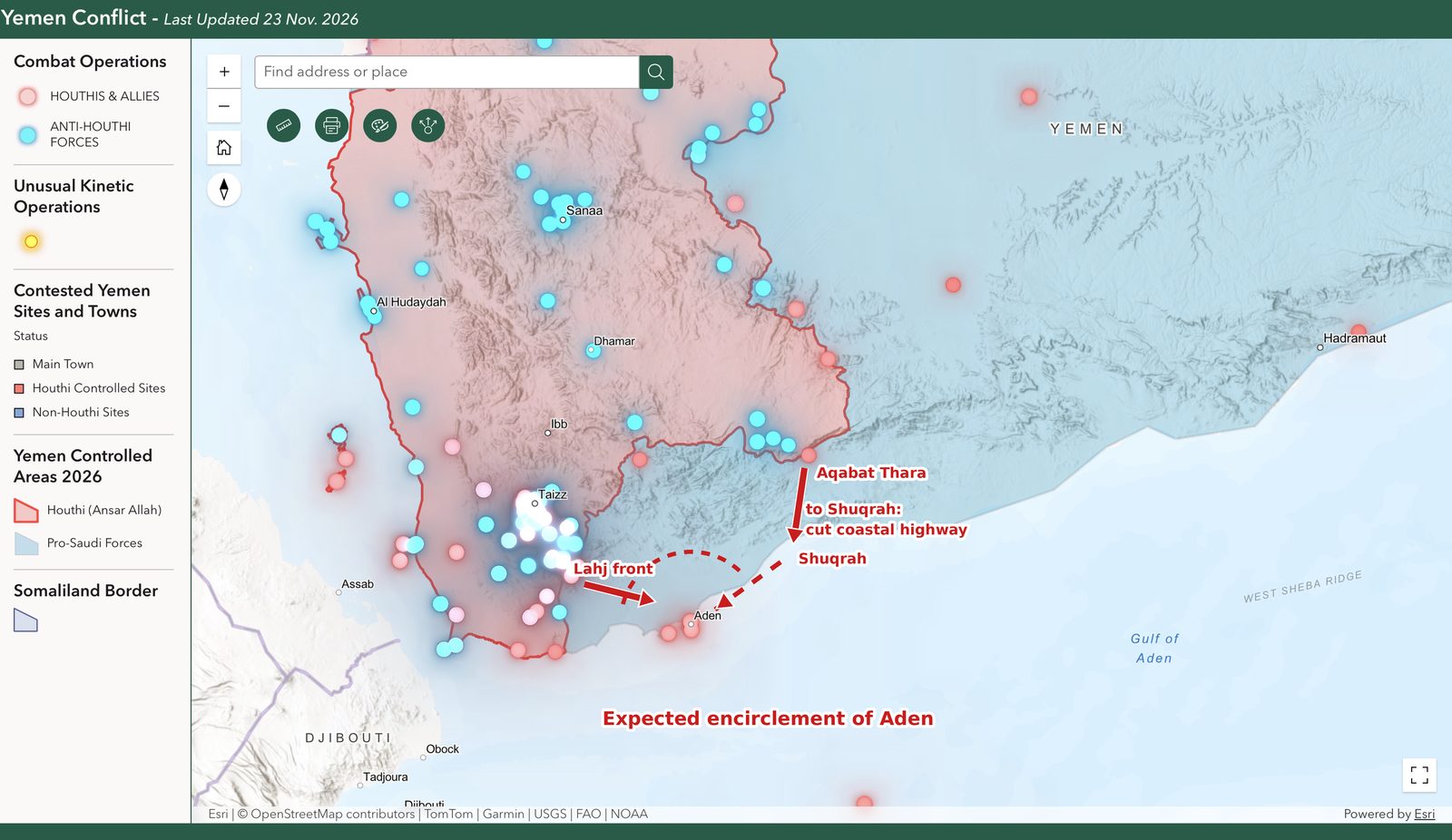
Map: Yemen Conflict map (ArcGIS), last updated 23 November 2026. Arrows added by me.
Why I'm betting "No"
1. Terrain. Aden itself lies on a flat coastal plain, but the routes towards it run through the mountains of Lahj and passes like Aqabat Thara. There, defenders control the high ground, roads and supply routes, so the fast gains on the coast shouldn't be extrapolated. And the terrain cuts both ways: once the Houthis come down onto the plain around Aden, they lose that cover and become exposed to Saudi airstrikes (see point 3).
2. Defence of Aden. Aden is compact, strategically vital and a clear priority for the government-aligned forces, which now work together to defend it. That is notable: in January 2026, some of these militias were still fighting each other, when Saudi-backed government forces took Aden from the UAE-backed Southern Transitional Council (STC). The cooperation is key to my thesis, but fragile.
3. Saudi air power. Saudi Arabia has sharply increased its airstrikes. Closer to Aden, the terrain flattens, and Houthi troops and supply lines on predictable routes become far more exposed.
4. Taiz. Taiz remains under Houthi siege. Opening a second major front towards Aden would stretch troops and logistics. I expect the Houthis to consolidate around Taiz first.
5. Counterattacks on other fronts. The government and allied militias are not only defending. They have launched counterattacks elsewhere, including an offensive in Al-Bayda and attempts to break the siege of Taiz. Even where these haven't produced breakthroughs, they force the Houthis to commit troops and resources to holding those fronts, resources they can't use for a push on Aden.
6. Regional response. A serious threat to Aden could draw in more outside actors. The Houthis are designated a terrorist organisation by several governments, and Saudi Arabia has a wide network of security partners. Israel has reportedly offered to help Saudi Arabia, and regional security talks involve Pakistan and Turkey, alongside diplomatic developments involving Syria. An assault on Aden risks escalating into a broader confrontation.
7. Encirclement first. The logical first step is to encircle Aden and cut its supply routes, which is where most of the fighting is now. The key choke point is Aqabat Thara: breaking through would let the Houthis descend into Abyan, cut the coastal highway and isolate Aden from Saudi Arabia and the oil-rich east. Government forces and militias are fighting back hard and counterattacking to prevent this.
The latest maps show this eastern pincer is already moving. Between 24 and 26 November, the Houthis advanced near Ad-Durayb, south of the Thara area, with Shuqrah on the Abyan coast as a possible next objective. That matters, but it also shows how far there still is to go: even taking Shuqrah would cut Aden off from the east, not put Houthi forces inside the city.
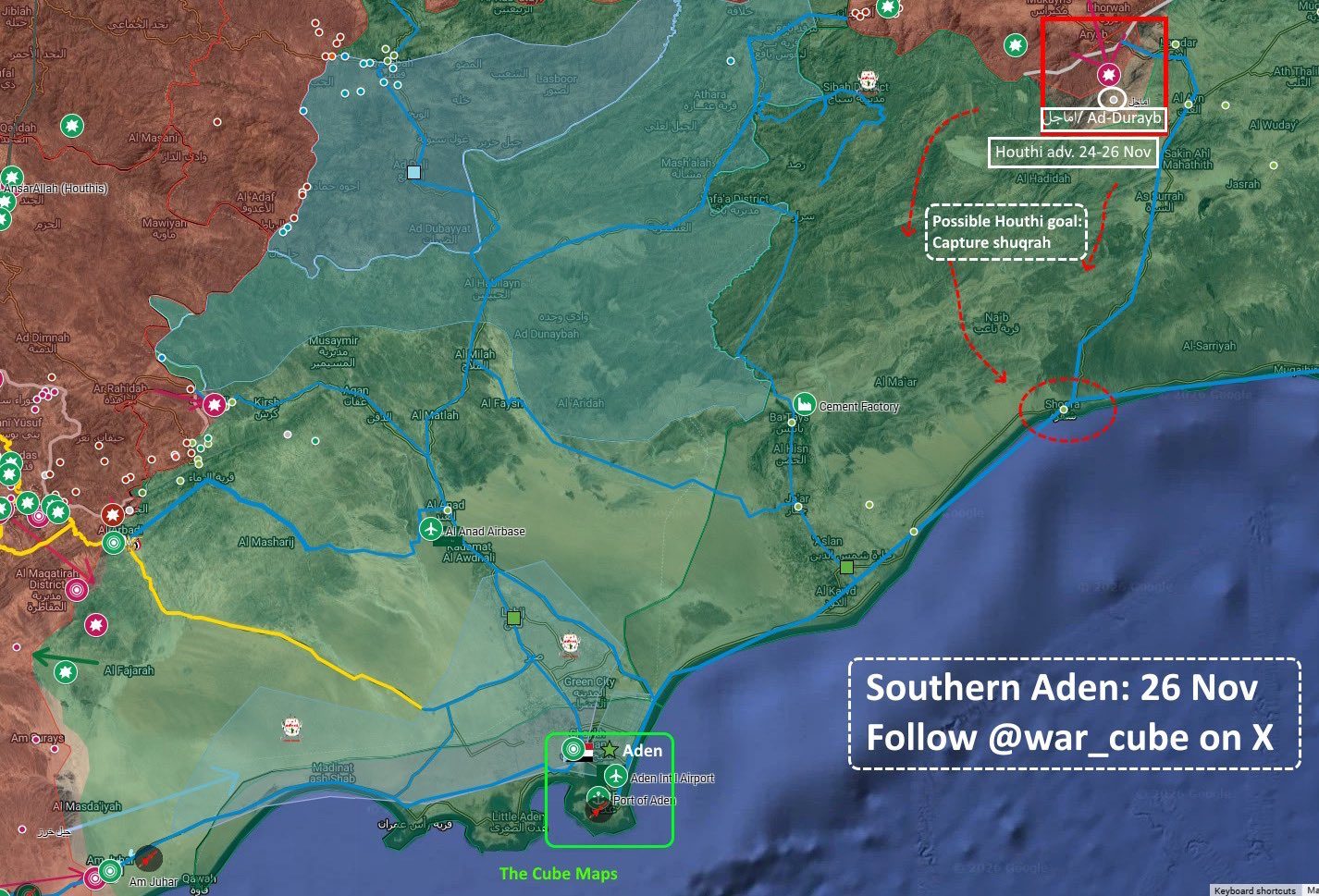
Map: The Cube Maps (@war_cube on X), 26 November 2026.
8. Time. Only 33 days remain. Even with intent, the Houthis would need major progress very quickly.
What would change my mind
As long as the defenders stay coordinated and prevent encirclement, I see little reason to expect a direct assault. Two indicators would make me reassess:
- A breakthrough around the city: Houthi progress at Aqabat Thara into Abyan, or towards cutting the coastal highway and Aden's main supply routes. The advance near Ad-Durayb in late November is the first thing I'm watching: if Shuqrah falls, I will reassess.
- Cracks in the alliance: given that these militias fought each other in January 2026, visible infighting among Aden's defenders would sharply weaken my thesis.
Why the market could be overpricing "Yes"
Fake news is common in this conflict. Videos claiming to show advancing Houthis or fleeing government troops often turn out to be old or misrepresented. Traders who react to them can push the odds towards "Yes" before the facts catch up.
Probability, expected value and risks
My estimate is about 10% for "Yes", so 90% for "No". At $0.82 for "No" (18% implied "Yes"), that's an 8-point edge:
- Expected value per share: $0.90 - $0.82 = $0.08
- Expected return: $0.08 / $0.82 ≈ 9.8% (gross)
Risks:
- Sudden collapse: the coastal advance, including Mocha, was fast. A similar breakdown around Aden is the main tail risk.
- Low bar: a brief presence in one neighborhood is enough for "Yes".
- Fragile alliance: if old rivalries resurface, the defence could weaken quickly.
- I could be wrong: AI said 30%, the market says 18%.
- Asymmetric payoff: I win $0.18 per share if right and lose $0.82 if wrong.
- Fees and the spread reduce the return.
A note on timing
This post reflects my views and market conditions on November 28, 2026. It will not be changed afterwards.
This update is for education only. It is not investment advice or a recommendation to buy, sell or hold any security. Companies are mentioned to illustrate how to think about news, not as opportunities.